


Today’s Favorite Quote: Life shrinks or expands in proportion to one’s courage - Anais Nin
Happy Birthday to those who have passed on and to those great wrestlers still with us:
In Memoriam:
Joyce Grable 1952
Happy Birthday:
Nick Patrick (67)
Chris Jericho (56)
Pete Dunne (33)
RIP Memorial: We stop & remember those who have passed on this day and gave themselves to the business for us, the fans. We salute you and thank you.
Rube Wright 11-9-1983 at the age of 76

Joe Scarpello 11-9-1999 at the age of 76

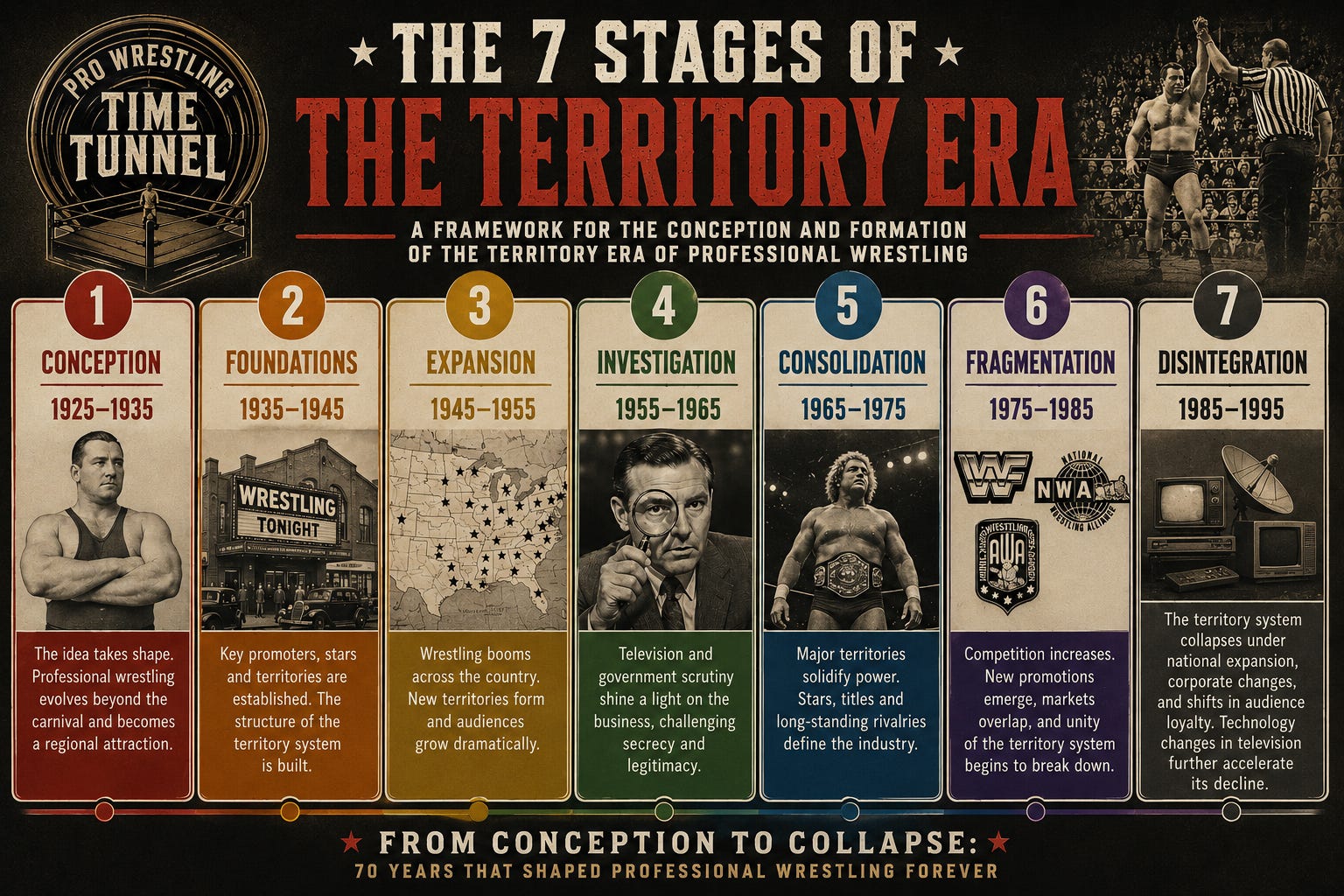
7 Stages of the Territory Era
Stage 4: Investigation
Year Two, Month Eleven
November 1956
The Belt Comes Home
November is the month the recognized champion changed hands again, three weeks after the judgment that was supposed to stop the Alliance from rationing him. Lou Thesz took the National Wrestling Alliance World Heavyweight Championship from Whipper Billy Watson on November 9 at Kiel Auditorium in St. Louis. Four days later he wrote Sam Muchnick a letter about percentages, transportation, and a humane schedule. The letter was reprinted in an NWA bulletin on the 16th. The investigation had become a judgment in October. In November it became a booking conversation between the man who held the belt and the man who had just signed the paper that said the belt could not be used to police towns.
The finish at Kiel
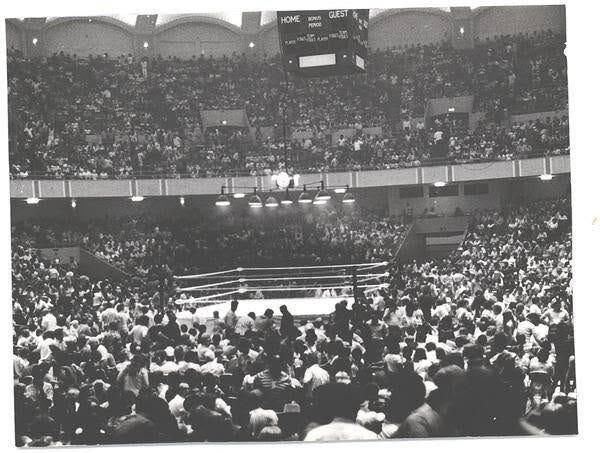
St. Louis, Friday, November 9, Kiel Auditorium, Sam Muchnick’s Sports Attractions. About 9,000 in the house. One fall. Thirty-seven minutes and five seconds.
Watson was the champion. He had held it since March 15 in Toronto, Jack Dempsey the special referee, a count-out win over a Thesz who was working on a bad ankle. The November match was the reverse of that count-out, with more moving parts. Referee Wee Willie Davis was knocked out during the bout. Missouri State Athletic Commissioner Charles W. Pian assigned John Turner to replace him. Watson was unable to revive after a ten-count. Thesz, outside the ring, was being given a twenty-count. He returned before he was counted out and won the title. After the match Watson attacked the referee.
The undercard was ordinary Kiel:
Tex McKenzie over Sky-Hi Lee, Mighty Ursus over Barney Bernard and Emil Dusek in a handicap, Billy Darnell and Dr. Lee Grable over the Dusek brothers in two-of-three, Rocky Monroe and Carlos Moreno a draw. The title match was the one the building had been sold on. Muchnick, who had spent a decade making Kiel the place where Alliance championships were recognized, booked the change in his own building. The decree of October 15 had forbidden exclusive territories and the use of the champion as a booking instrument. It had not forbidden a member from putting the belt on the man the membership trusted.
The finish is the kind of result that survives a commission. A knocked-out referee, a substitute assigned by the state, a double count-out situation resolved by the champion’s return, a post-match attack. It looks like a fight that got away from the script. It also looks like a script that used the commission as cover. Both readings were available in 1956. The Alliance preferred the first. The Antitrust Division, three weeks earlier, had declined to try the second in open court.
The letter of November 13
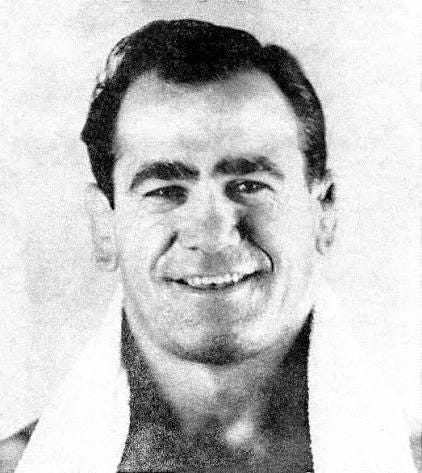
Pictured: Lou Thesz
Four days after the change, Thesz wrote Muchnick. The letter, reprinted in NWA Bulletin No. 3 dated November 16, is the clearest private document of how the championship worked in the month after the judgment. He was happy to have the title back. It had been his dream to hold it five distinct times, as Ed “Strangler” Lewis had. He wanted the Alliance to book him again. He noted that the NWA had made it possible for him to draw the large gates he had drawn, “mainly because they cleared up the heavyweight championship situation through elimination.”
Then the economics. The champion wrestled for 15 percent of the gross after taxes on each appearance. Of that 15 percent, 11 went to the titleholder. The remaining 4 percent went to the NWA to take care of Lewis and the president’s office. Later bulletins put Lewis’s annual figure at $7,500. Muchnick’s share for booking the champion and holding the presidency had been, in earlier years, a percentage that sometimes fell short of a $15,000 target, with members assessed to make up the difference. In 1954 Muchnick had made roughly $13,000 from the office and the booking; Thesz himself was estimated around $52,000. The numbers are not a secret ledger. They are the published custom of the belt.
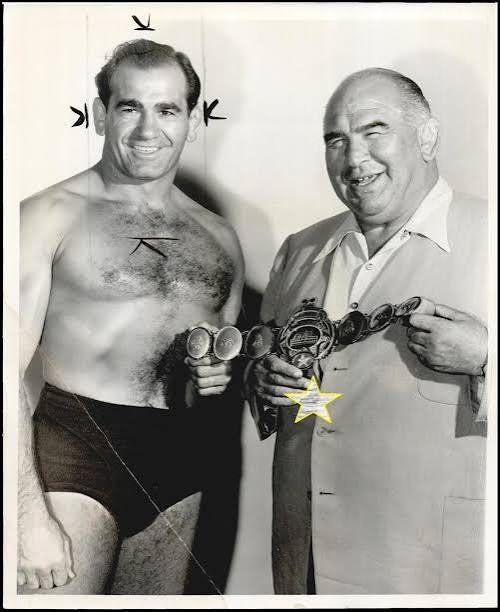
Pictured: Thesz and Ed “Strangler” Lewis
Thesz also asked for conditions. First-class transportation, because a champion representing a sport should travel properly. The right to veto an opponent if a deserving man was being passed over for a Johnny-come-lately. A humane schedule: two weeks of five days, then a week off, rather than the three-weeks-on, one-week-off pattern that left the champion working his off week when a town needed him. Muchnick answered that he would book him.
The rift that had opened in 1955 over schedule and pay was, for the moment, papered over by the return of the belt. Read against the October 15 judgment, the letter is the hole the bookers used. Championship recognition was not listed among the forbidden agreements. The Alliance could still say who the recognized champion was. A member could still pay the percentage.
What the decree forbade was an agreement that only one member in a territory could buy that percentage, or that a wrestler who worked the other show would never work again. Thesz’s letter assumes the first half of that distinction. He wants to be booked by the Alliance. He wants the percentage. He wants a say in who he faces. He does not ask for the exclusive-territory clause back. He does not need to. The belt is still the premium product. The decree has not yet priced it out of the market.
The Toronto return and the Canadian month
The belt did not stay in St. Louis. On November 22, Maple Leaf Gardens, Frank Tunney’s office, Thesz and Watson went to a curfew time-limit draw at 11:00, 42 minutes and 11 seconds, in front of about 11,000. Jack Sharkey was among the officials. The card also had the Brunetti brothers over the Gallagher brothers, Buddy Rogers over Shag Thomas in nine minutes, Bobby Managoff over Joe Christie, Gene Kiniski over Maurice LaPointe.
That draw is the political sequel. Watson had taken the title in Toronto in March. Thesz had taken it back in St. Louis in November. The return match in Watson’s building, under curfew, with no change, left both men strong and left Tunney with a house. The decree said the Alliance could not allocate the champion to protect a member’s territory. The November 22 card looks like ordinary booking: the new champion works the old champion’s town, the finish protects the local hero, the gate is paid. Whether that is compliance or the old custom under a new name is the question Stage 4 leaves open.
Toronto’s November without the belt still ran. November 1, Watson still champion, beat Mr. Moto by disqualification, Rogers on the undercard, about 8,000. November 8, Watson beat Moto again, special referee Wee Willie Davis, Rogers challenged, about 6,000. November 15, the first Gardens card after the change, Brunettis and Hito–Moto to a curfew draw, Rogers over Red Lyons, about 6,000. November 29, East York Arena because of the Ice Capades, Rogers and Watson both counted out in a bloody match, 1,800. The champion’s absence did not close the building. It changed the main event.
Montreal was Eddie Quinn. November 1, Ottawa: Thesz beat Hard Boiled Haggerty by disqualification. November
Montreal Forum: Wladek Kowalski, Montreal world champion, beat Thesz by disqualification in a title match. Thesz, a week before he regained the Alliance belt, lost a local title match on a disqualification. That is the Northeast as it actually worked: Quinn’s towns had their own recognized champion, Rogers and Kowalski as the imported and the local heels, and the Alliance belt as a visitor rather than a governor. November 24 and later Forum cards continued the Rogers–Robert–Baillargeon program. Quinn was a consenting member. His November loop did not reorganize around the decree. The prairie offices ran without the world champion. Stu Hart’s Big Time Wrestling had its own November cards in Alberta and Saskatchewan. Winnipeg had its own. The decree’s territorial ban applied to a province the same way it applied to a state. November did not test it with an invasion. It tested it by continuing.
The American map after the change
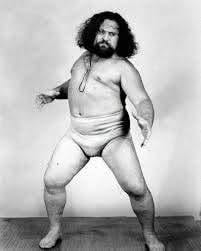
Pictured: Baron Gattoni
Thesz’s first defenses after Kiel were ordinary title dates, not spectacles.
November 19, Niagara Falls Memorial Arena: Thesz beat Bobby Managoff, two falls to one. November 21, Buffalo Memorial Auditorium: Thesz beat Baron Gattoni in a title match; one attendance figure from the period puts the house near 11,000. November 28, Zanesville Municipal Auditorium: Thesz beat Frankie Talaber, two of three, on a benefit for the Charity Newsies, Barbara Baker over Mae Weston on the undercard. November 29, Dayton: Thesz beat Jim Bernard.
Ohio was still Al Haft’s Midwest Wrestling Association. The champion who had been Watson in October was Thesz in late November. The office did not change. The belt did.
Chicago was Fred Kohler. November 9, the same night as Kiel, International Amphitheatre: the Lisowski brothers (Reggie Lisowski and Stan Holek) beat Verne Gagne and Wilbur Snyder for the Chicago world tag title by disqualification. Marigold Arena on the 3rd, 10th, 17th, and 24th ran the television habit — Hans Schmidt defending the United States television title, Angelo Poffo, the Volkoffs, Yukon Eric, Antonino Rocca on the 17th. Schmidt’s television belt was the one a Midwest office could book without waiting for the world champion.
Gagne was the amateur name, working Chicago, Milwaukee, Winnipeg, Buffalo, and Omaha as the local hero against foreign heels and against Schmidt.
Omaha, Max Clayton, November: June Byers over Penny Banner for the women’s world title on the 5th; Antonino Rocca over Angelo Poffo on the 12th, about 1,990; the 19th a benefit for the Nebraska Diabetics Fund in which Bronko Lubich and Poffo beat Gagne and Schmidt after Schmidt refused to tag and then attacked his own partner, about 2,240; the 26th a smaller house. The upper Midwest in November is television names and local feuds, not the world title. That is how a territory survived a week the champion was elsewhere.
VIDEO: NWA Women’s World Champion June Byers vs Penny Banner from “The First Lady of Wrestling” documentary
Texas was a small handful of offices. Ed McLemore’s Dallas Sportatorium ran November 20 and 27 with Bull Curry, Pepper Gomez, El Medico, Duke Keomuka, Sam Steamboat, Lee Henning. A December tournament would set up a Thesz defense against Luther Lindsey, with a $5,000 guarantee bond attached to the challenger. The champion was not in Texas in November. The towns ran. Doc Sarpolis’ western loop and Morris Sigel’s Houston office did the same. The decree had not opened Dallas to an opposition card. It had made the old exclusive claim illegal to write down.
The rest of the map held. Boston, Paul Bowser. The Northeast beyond Montreal, Pedro Martinez and the Capitol towns. The Carolinas, Jim Crockett. Florida, Cowboy Luttrall. Tennessee and Alabama, Nick Gulas and Roy Welch. Los Angeles and San Francisco, the television and house-show habit that had given the Division its 1955 victims. Hawaii, Al Karasick. The Pacific Northwest, Don Owen. The central states — Kansas City, St. Joseph, Des Moines — still the knot that Myers v. George would spend the next eight years untying. Pinkie George was still the Iowa name. The decree was three weeks old. The private suit was still waiting for its first jury.
Mexico in November
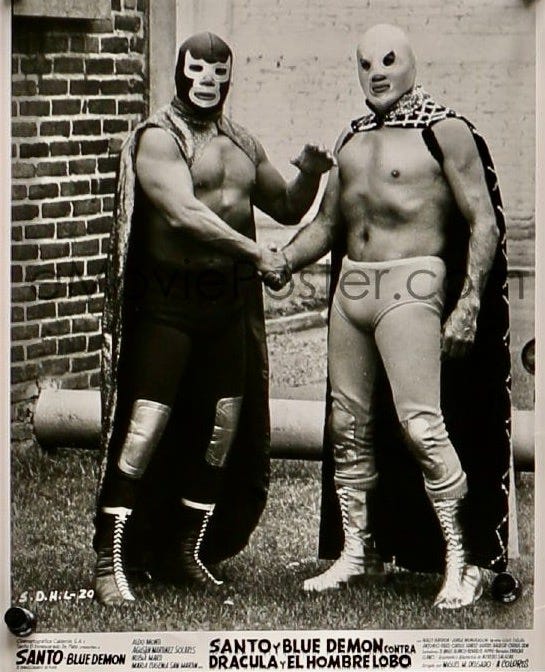
Mexico remained outside the Iowa judgment and inside the month.
The Santo–Blue Demon feud was a tag program. November 4, Arena Coliseo, one-night tournament quarterfinal: El Gladiador beat Blue Demon. November 10, Arena Puebla: El Santo and Espectro beat Blue Demon and Rolando Vera. November 11, Arena Coliseo: Cavernario Galindo and El Mongol beat Blue Demon and Henry Pilusso. November 18, Arena Coliseo, tag tournament: Blue Demon and Henry Pilusso advanced through the quarterfinal and semifinal. November 24, Arena Puebla: Santo and Espectro beat Black Shadow and Blue Demon. November 25, Arena Coliseo: Blue Demon and Henry Pilusso beat Masahiko Kimura and Teizo Watanabe. Vera, who had taken the NWA World Middleweight Championship from Santo on October 19 in Monterrey, was working the tag program in November rather than defending the middleweight belt in the capital every week.
Kimura, the Japanese judoka whose 1954 shoot with Rikidozan had made him a name, was in Mexico City on the 25th. The masked economy and the commission system continued. EMLL’s Sunday and Friday cards at Coliseo and the Puebla loop were the weekly habit. The decree that had voided exclusive territories in Iowa did not void a mask or a Mexico City building.
Japan in November
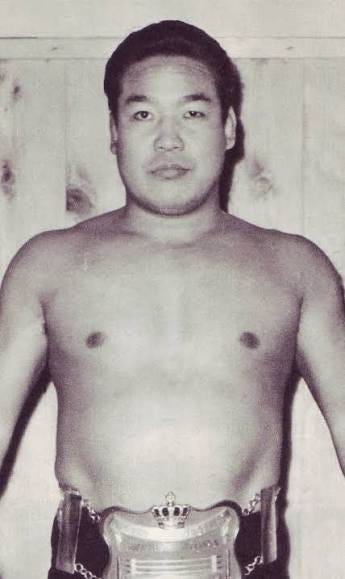
Pictured: Junzo Yoshinosato
Japan in November 1956 was still between the spring Sharpe tour and the autumn 1957 meetings with Thesz. The domestic tournament work of October had crowned Yoshinosato, Surugaumi, and a heavyweight draw. November does not show a major American import series. Rikidozan’s office was building the national style — sumo names, the karate chop, the American visitor used when he served the house — without needing a foreign world champion on the card every month.
The business contrast with the Alliance is the same one October established. The Iowa judgment regulated a North American booking club. The Japan Wrestling Association was a national promoter that took Alliance champions as guests and ignored Alliance law when it did not serve the gate. November did not test that relationship with a title match. It confirmed that the Japanese promotion could run a month without one.
Storylines the towns actually sold
VIDEO: Hans Schmidt vs Verne Gagne, International Ampitheater, Chicago, Illinois
The month’s programs were local, with the title change as the one continental fact.
Thesz against Watson was the protected sequel. St. Louis count-out on the 9th, Toronto curfew draw on the 22nd. Both men left strong. Tunney kept his house. Muchnick kept the recognition. Rogers remained the heel who could be beaten only by disqualification or curfew, working Toronto, Montreal, and the undercards. Kowalski was the Montreal champion who could beat Thesz on a disqualification a week before Thesz became Alliance champion again. That sequence is the Northeast telling the Alliance belt it is a visitor.
Gagne against Schmidt, and Gagne against the Volkoffs and the Kalmikoffs, was the upper-Midwest television feud. Schmidt’s United States television title was the belt that did not require a phone call to St. Louis. Byers against Banner was the women’s world title on an Omaha card. The Duseks, Poffo, Yukon Eric, the Lisowskis — the men who filled the towns the champion was not in
In Mexico the program was still the mask code. Santo and Espectro as a team, Demon with Pilusso or against Shadow, Vera in the mix after the middleweight change. No mask match. The offices had more use for both men masked.
None of these programs mentioned the decree. The finishes did not change because a judgment had been entered in Des Moines. Kayfabe and the Sherman Act remained different sentences.
Business analysis: Stage 4, the first full month under the judgment
Stage 4 is the investigation. October made it a judgment. November is the first full month the judgment was in force while the live business ran at ordinary volume.
The gates that can be stood on are local. Kiel, about 9,000 for the title change. Maple Leaf Gardens, about 11,000 for the rematch draw. Buffalo, a reported house near 11,000 for Thesz against Gattoni. Omaha, 1,990 and 2,240 on ordinary Mondays. East York Arena, 1,800 when the Ice Capades took the Gardens. These are not boom numbers and they are not collapse numbers. They are the weekly habit.
The decree did not move them in November.
The champion’s economics, spelled out in the November 13 letter, are the business the judgment did not touch. Fifteen percent of the gross after tax. Eleven to the man, four to the office and to Lewis. First-class travel as a request, not a right. A schedule that the booker could still override when a town needed the shot. Thesz’s happiness at regaining the title, and his request to be booked by the Alliance again, assume that recognition and the percentage survive the bylaw rewrite. They did.
Membership math is still the delayed bill.
The drop Muchnick would describe in 1959 — more than fifteen members gone because the Alliance could no longer offer a promoter anything of value for his fee — is not visible in the November cards. The towns that ran in October ran in November. George was still the Iowa name. Bruns had not yet booked Des Moines against him in a way that Muchnick could wave at the Division as proof the decree was working. That letter is 1960. November 1956 is the month the paper was new and the habit was old.
Television remains the unregulated half of the business. Kohler’s Marigold tape, the Los Angeles and Tampa tapes, Tunney’s Gardens shows, Bowser’s Boston cards — all of them used the box as the advance man for the armory. The decree regulated agreements among members about territories and blacklists. It did not regulate the sale of time to a station. November’s television champions — Schmidt’s United States belt, the Chicago tag belts — were booked by offices that no longer needed the Alliance’s permission to fill a screen. The investigation had aimed at the 1948 club. The 1956 business was that club plus a set of television producers. The judgment hit the club.
Mexico and Japan measure the geographic limit. Santo and Demon in Puebla and Coliseo, Vera holding the middleweight belt he had won in Monterrey, Kimura working a Mexico City tag match — none of it was booked under the Iowa order. Rikidozan’s November, whatever domestic cards it contained, did not require an Alliance champion. The territorial system under investigation was real. It was North American. The month makes that plain by running three other businesses at full speed while the Alliance’s new bylaws sat in a St. Louis file.
What November settles
October 15 was the filing. November 9 was the next use of the instrument the filing had tried to blunt. Thesz regained the title in the building of the man who had signed the decree. Four days later he wrote that man a letter about the percentage, the schedule, and the dream of five reigns. On the 22nd he went to Toronto, drew with the man he had beaten, and left 11,000 people with a finish that protected the local hero.
The live month is Thesz’s return and Watson’s survival. St. Louis count-out, Toronto curfew draw, Buffalo and the Ohio towns, Montreal’s local title on a disqualification the week before. Rogers still the heel. Gagne and Schmidt still the television program. Byers still the women’s champion on an Omaha card. Santo and Demon still tagged against each other. The Japanese office still able to run without a foreign belt.
The business month is the letter. The decree had voided exclusive territories and the blacklist. It had not voided championship recognition or the 15 percent. Thesz’s November 13 note is the champion asking to be booked under the new rules and assuming the old economics. Muchnick’s answer, and the bulletin that printed the letter, are the Alliance agreeing. Stage 4, as a government investigation, was already closed. Stage 4, as a condition of the territory, was the argument over whether a percentage, a recognized champion, and a town that did not get invaded still added up to the monopoly the judgment had forbidden. November did not settle that argument. It showed that both sides could live with it for a month.
Thank You for Watching and Listening
I’m Tony Richards, Pro Wrestling Historian, Author and Storyteller. I share pro wrestling historical items in each issue of the Time Tunnel Pro Wrestling History Newsletter and each episode of our podcast show. Thanks for your support! If you enjoy my information on select events, matches and insights, please share with folks you think might like to be a subscriber!
Remember, Premium subscribers get access to exclusive and special content such as some special issues including a multi-part deep dives on wrestling territories, wrestler bios and championship title histories, special audio and video interviews on territory pro wrestling and more available in the Pro Wrestling Time Tunnel for Premium Subscribers. Being a Premium Subscriber also means you support me in my efforts to document Pro Wrestling History through my research, writing, books, vidoes and podcasts. And…I have something very special planned for our Premium Subscribers on the Podcast side of things in 2026! Details soon here in the Pro Wrestling Time Tunnel.